How to march
Mahablog posted this up a while back and it makes a lot of good points and unlike me, she marched during the Vietnam War.
April 12, 2006 Long-time Mahablog readers probably have noticed I am ambivalent about protest marches and demonstrations. Even though I take part in them now and then, on the whole I don’t think they have much of an effect. Ah-HAH, you say. The immigration marches just showed you. So why isn’t the antiwar movement marching all the time? Good question. Sometimes it ain’t what you do, but the way that you do it, that matters. Some demonstrations have changed the world. But in my long and jaded experience some demonstrating is a waste of time. Some demonstrating is even counterproductive. What makes effective protest? I’ve been thinking about that since the big antiwar march in Washington last September (when I suggested some rules of etiquette for protesting). I started thinking about it more after Coretta Scott King died, and I saw photos like this in the newspapers: 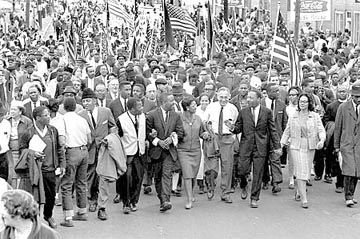
What’s striking about that photo? Notice the suits. Yeah, everybody dressed more formally back in the day. But it brings me to – Rule #1. Be serious. The great civil rights marches of the 1950s and 1960s should be studied and emulated as closely as possible. People in those marches looked as if they were assembled for a serious purpose. They wore serious clothes. They marched both joyously and solemnly. They were a picture of dignity itself. If they chanted or carried signs, the chants or signs didn’t contain language you couldn’t repeat to your grandmother. The antiwar protests I’ve attended in New York City, by contrast, were often more like moving carnivals than protests. Costumes, banners, and behavior on display were often juvenile and raunchy. Lots of people seemed to be there to get attention, and the message they conveyed was LOOK AT ME LOOK AT ME LOOK AT HOW CLEVER I AM, not NO IRAQ WAR. Really. Some street theater is effective — I am fond of Billionaires for Bush — but most of the time street theater is juvenile and tiresome and reminds me of bad summer camp skits. Except raunchier. Which takes me to –
Rule #2. Be unified of purpose. One of my ongoing gripes about antiwar marches is the way some groups try to tack their own agenda, which many others in the demonstration may not share, onto marches. International A.N.S.W.E.R. is a repeat offender in this category. Most of the marchers last September were in Washington for the sole purpose of protesting the war. But ANSWER hijacked CSPAN’s attention and put on a display so moonbatty it made The Daily Show; see also Steve Gilliard. Message control is essential. During the Vietnam era, I witnessed many an antiwar protest get hijacked by a few assholes who waved North Vietnamese flags and spouted anti-American messages, which is not exactly the way to win hearts and minds – Rule #3 — Good protesting is good PR. I know they’re called “protests,” but your central purpose is to win support for your cause. You want people looking on to be favorably impressed. You want them to think, wow, I like these people. They’re not crazy. They’re not scary. I think I will take them seriously (see Rule #1). That means you should try not to be visibly angry, because angry people are scary. Anger is not good PR. Grossing people out is not good PR. Yelling at people that they’re stupid for not listening to you is not good PR. Screaming the F word at television camera crews is not good PR. Rule #4 — Size matters. Size of crowds, that is. Remember that one of your purposes is to show off how many people came together for the cause. But most people will only see your protest in photographs and news videos. More people saw photographs of this civil rights demonstration in August 1963 than saw it in person – 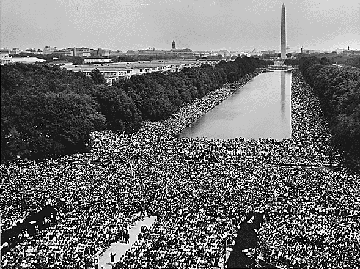
The number of people who marched for immigration reform over the past few days was wonderfully impressive. It’s the biggest reason the marches got news coverage. The overhead shots were wonderful. On the other hand, last September I wrote of the Washington march – The plan was to rally at the Ellipse next to the White House and then march from there. Only a small part of the crowd actually went to the Ellipse, however. Most seem to have just showed up and either stayed in groups scattered all over Capitol Hill, or else they just did impromptu unofficial marches as a warmup to the Big March. … It would have been nice to get everyone together for a mass photo, but that didn’t happen. Too bad. It would have been impressive.
As I waited on the Ellipse I could see vast numbers of people a block or two away. The Pink Ladies had a big contingent and were busily showing off how pink they were — LOOK AT ME LOOK AT ME LOOK AT HOW CLEVER I AM — but they seemed to evaporate once the official march started. (Re-read Rules #1 and #2.) Anyway, as a result, there were no photos or videos to document for the world how big the crowd really was. You had to be there. A sub-rule — IMO, an occasional REALLY BIG demonstration that gets a lot of media attention is way better than a steady drizzle of little demonstrations that become just so much background noise.. Rule #5 — Be sure your opposition is uglier/more hateful/snottier than you are. In the 1950s and 1960s white television viewers were shocked and ashamed to see the civil rights marchers — who were behaving nicely and wearing suits, remember — jeered at by hateful racists. And when those redneck Southern sheriffs turned fire hoses and attack dogs on the marchers, it pretty much doomed Jim Crow to the dustbin of history. I think Cindy Sheehan’s encampment in Crawford last August, although a relatively small group, was such a success because of the contrast between Sheehan and the Snot-in-Chief cruising by in his motorcade without so much as a how d’you do. Truly, if Bush had invited the Sheehan crew over for lemonade and a handshake, the show would’ve been over. But he didn’t. This takes us back to rules #1 and #2. You don’t win support by being assholes. You win support by showing the world that your opponents are assholes. Rule #6 — Demonstrations are not enough. It’s essential to be able to work with people in positions of power to advance your agenda. And if there aren’t enough people in power to advance your agenda, then get some. Frankly, I think some lefties are caught up in the romance of being oppressed and powerless, and can’t see beyond that. Remember, speaking truth to power is just the first step. The goal is to get power for yourself. Any more rules you can think of?
Labels: Iraq, protest, washington
Myth and reality

Recently people have commented that they'd like to see a general strike or a new anti-war movement, and frankly that amused me.
Because if you want to talk about living in the past, a fictional past, that's a good way to start.
Let's state the obvious: the anti-war movement failed. Badly.
It alienated the middle class, it failed to gain any congressional victories and anti-war legislators were defeated (Al Gore,Sr, Ralph Yarborough)while US troops were in Vietnam. It also led to two Nixon elections.
While many may feel some misty colored memories for the antiwar movement, it's mostly nostalgia. People say "we stopped the war" and I nearly have to laugh out loud. They didn't stop shit.
So how did the Vietnam War end?
The US Army stopped working.
By 1971, the US Army was rife with drug abuse, racial tension, and an inability to function in combat. Soldiers took to monkey wrenching the system. People want to give credit to a GI movement, but there is no evidence that other than writing newspapers and reflecting low morale, that it did anything to end the war.
The reality is that the soldiers opted for passive resistance, sometimes violent resistance. They wouldn't patrol, they would cover for people living off post, they would alter forms. In some cases, you had combat refusals or combat avoidance.
Even fragging has been overblown. Most of the violent assaults were committed by rear eschalon troops in disputes over drugs or race.
In 1970 this is the number of stockade rebellions in the US Army
1970
January
* Fort Carson - Sick-call.
January 28
* Great Lakes Naval Training Center - On-base riot.
March 2
* Mannheim Brig - Stockade rebellion.
March 13
* Mannheim Brig - Stockade rebellion.
April
* Stanford University - ROTC building damaged by fire.
* Fort Polk - Stockade rebellion.
April 9
* Berkeley - Anti-ROTC demonstration turns into riot.
April 15
* Fort Carson - Sick call.
* Fort Dix SPD - Sick call.
* Fort Lewis - Messhall boycott.
* Fort McLellan - Messhall boycott.
* Fort McClellan - Sick call.
May 20
* Camp Humphries, South Korea - Attempted fragging. An American guard and three South Koreans were injured, helicopter badly damaged.
May 26
* USS Richard B. Anderson - Sabotage.
May 30
* Ponchon, South Korea - On-base riot.
June
* Mannheim - On-base riot
* MCRD San Diego - On-base riot.
* Oakland - Attempted fragging.
July 4
* Iwakuni MCAS - Stockade rebellion.
July 24
* Camp Pendelton - Armory broken into, 9 M-16s, grenade launcher and .45 pistol stolen.
July 25
* Camp McCoy - Western Electric transformer and the central telephone exchange bombed.
July 26
* Fort Hood - Stockade rebellion.
July 27
* Fort Scott - Outdoor model of a Niki Ajax Missile destroyed in an explosion.
* Mannheim Stockade - Stockade rebellion.
* North Beach - Bomb thrown at North Beach MP Station.
July 27
* Fort Dix - Stockade rebellion.
July 30
* Fort Carson - On-base riot.
August 6
* Fort Monmouth - Sabotage.
August 12
* Camp Pendelton SPD - On-base riot.
August 12 - 13
* Fort Ord - Stockade rebellion.
August 17
* Camp Pendelton Brig - Stockade rebellion.
August 20
* Berlin - Black GIs riot.
September 12
* Chanute AFB - On-base riot.
September 16
* Chanute AFB - Messhall boycott.
September 26
* Fort Carson - Stockade rebellion.
October
* Alameda NAS - On-base strike.
* Fort Benning - Stockade rebellion.
* USS Deeley - Sabotage.
October 27
* USS Ingram - Sabotage.
November 10
* Iwakuni MCAS - On-base riot.
December
* Kadena AFB - On-base riot.
December 20
* Fort Hood - Stockade rebellion.
By 1973, the US Army was barely able to function, with indiscipline in the ranks and open racial violence.
People want to claim this was some "movement" of GI resistance, but that's a bit much. There was no overarching goal, no political philosophy. And a lot of the underpinnings of the violence was racially motivated. Some people didn't belong in the Army, some just hated it.
The Army stopped working and that ensured it would leave Vietnam.
When people, especially those who live overseas, call for dramatic action like a general strike, they aren't aware of America 2007. America is a land of crushing debt and underpaid workers. Most families live paycheck to paycheck. To lose a job is to lose health care and risk homelessness.
When people protested in 1968, jobs were easy to get and keep. That isn't the case today.
But I'm going to argue something else: the current antiwar movement has been a raging success.
Why?
First, 70 percent of the public wants the war to end.
Second, recruiting has been crippled.
Third, there is now an antiwar majority in Congress. War opponents are given a full hearing in public. Unlike Nixon, Bush is reeling in the polls over the war. The "silent majority" is against Bush, as are most of the editorial pages.
This domination of the antiwar position allows people to ignore protests and limit their fallout. The damage ANSWER does is limited because they can't define the antiwar movement.
The power of this movement isn't in the streets, it's in blocking recruiters, it's in electing politicians. It does things, quietly, differently, but far more successfully than those wishing for a return of the 1960's.
George Bush doesn't care about protests, hell, he doesn't care about Congress. You want to end this war, you need politicians, not protests.Labels: antiwar, Iraq, protest, Vietnam
A new movement

(AFP/Nicholas Kamm)
Student Protesters, Fighting Image of Apathy, Call for a Cohesive Movement
Student Activists Call for Peace, a Cohesive Movement at U.S. Colleges
By Megan Greenwell
Washington Post Staff Writer
Sunday, January 28, 2007; Page A08
As the bulk of war protesters chanted "this is what democracy looks like" on the Mall yesterday, a few hundred gathered separately on the south edge of the Mall.
Members of the College Democrats of America mingled with the more radical Students for a Democratic Society and the Communist Youth Movement. Many held signs proclaiming themselves "another future leader against the war." Some danced. Some clapped. Others passed around a joint. Disparate in their affiliations, they were united in their chants: "College, not combat."
Since the war began nearly four years ago, many Vietnam-era antiwar activists have publicly lamented what they see as apathy among today's college students. They wonder whether the absence of a draft and a culture of pop music and reality television have distracted young people from civic responsibilities.
But among the hundreds of students on the Mall yesterday, dozens of whom drove all night to get to Washington for the protest, the prevailing sentiment was that their generation had been unfairly maligned and that the antiwar movement is growing stronger every day.
"I do think we're misrepresented as being lazy, ignorant and unaware of current events," said Sarah Searle, 19, a sophomore at the University of Virginia. "There's no huge movement going on like during Vietnam, but that doesn't mean we're apathetic."
The students at yesterday's protest noted that their efforts have not had the iconic touchstones of the late 1960s and early 1970s, when shootings at Kent State and the student takeover at Columbia University stirred U.S. consciousness. Still, there are signs, they said, of a building resistance to the war in Iraq and other U.S. foreign policy initiatives.
Labels: protest, washington
We are the majority

Tens of thousands march against Iraq war
By CALVIN WOODWARD and LARRY MARGASAK, Associated Press Writers 1 hour, 14 minutes ago
WASHINGTON - Convinced this is their moment, tens of thousands marched Saturday in an anti-war demonstration linking military families, ordinary people and an icon of the Vietnam protest movement in a spirited call to get out of
Iraq.
Celebrities, a half-dozen lawmakers and protesters from distant states rallied in the capital under a sunny sky, seizing an opportunity to press their cause with a Congress restive on the war and a country that has turned against the conflict.
Marching with them was Jane Fonda, in what she said was her first anti-war demonstration in 34 years.
"Silence is no longer an option," Fonda said to cheers from the stage on the National Mall. The actress once derided as "Hanoi Jane" by conservatives for her stance on Vietnam said she had held back from activism so as not to be a distraction for the Iraq anti-war movement, but needed to speak out now.
The rally on the Mall unfolded peacefully, although about 300 protesters tried to rush the Capitol, running up the grassy lawn to the front of the building. Police on motorcycles tried to stop them, scuffling with some and barricading entrances.
Protesters chanted "Our Congress" as their numbers grew and police faced off against them. Demonstrators later joined the masses marching from the Mall, around Capitol Hill and back.
United for Peace and Justice, a coalition group sponsoring the protest, had hoped 100,000 would come. Police, who no longer give official estimates, said privately the crowd was smaller than that.
As I was watching this, unimpressed with the t-shirts and silly slogans which seem par for the course, when I saw Jane Fonda, I shook my head. I thought "is this a person you really want to make a point with?"
Then I said, "fuck it. We're the majority, we're the ones in the right. Let them bring Jane Fonda on, because she's with 70 percent of the American people and only the freaks support Bush and his warmongering"
We need to act like Bush is the one outside the mainstream, supporting this insane war of his. Sean Penn, Jane Fonda and Susan Sarandon are standing with the American peopleLabels: Iraq, protest, washington
|


